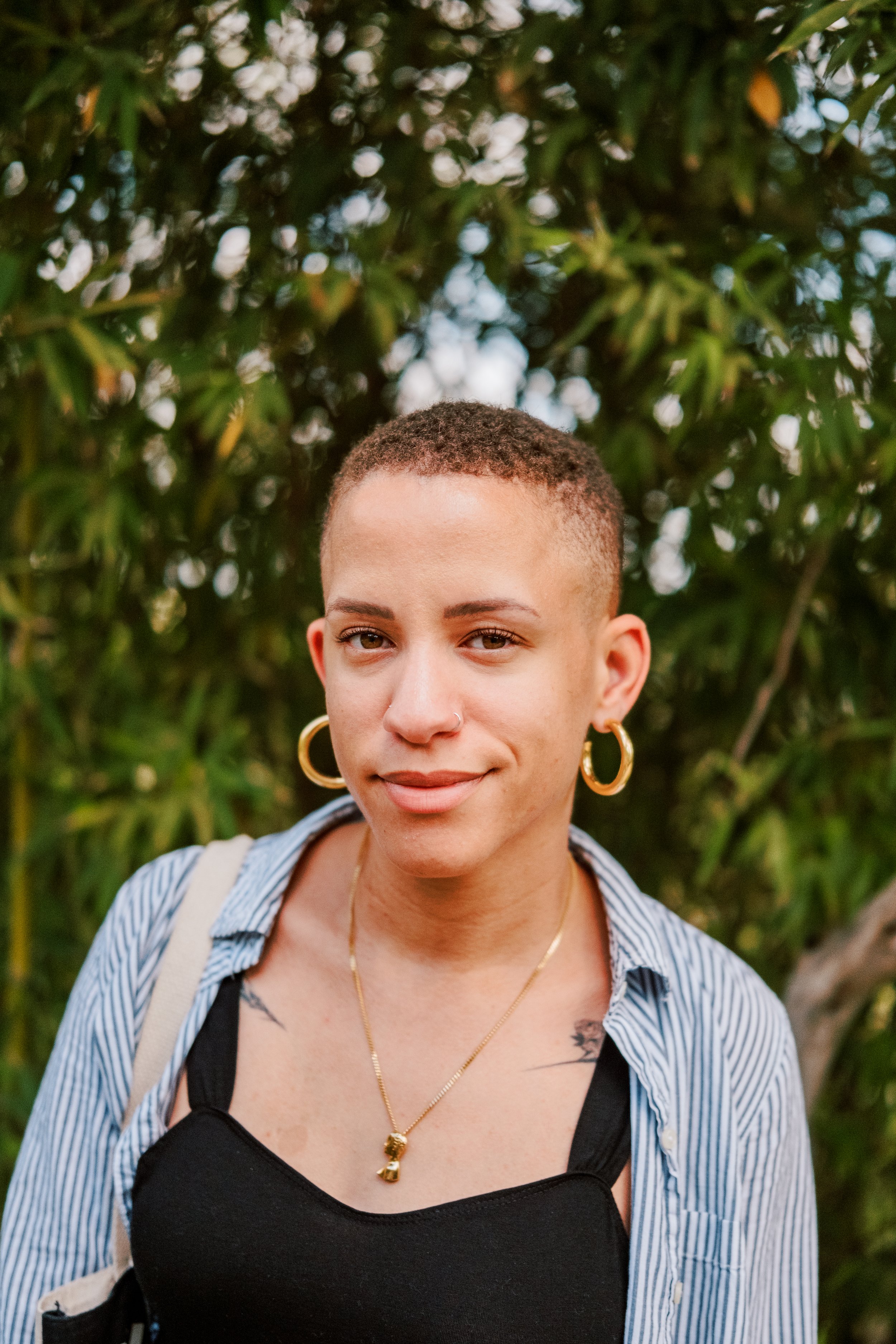
Amarys Dejai in Conversation with American Poet Rachelle Toarmino
In this conversation with Sontag Mag Staff Interviewer Amarys Dejai, poet Rachelle Toarmino discusses her newest collection of poetry, Hell Yeah, and her attention to the vitality of everyday speech. She reflects on doubt and doubling down as the engine of her thinking, poetry as an act of eavesdropping, and the perspectives explored in her upcoming project.
I want to start off by talking about your latest work. Your most recent collection, Hell Yeah, turns to the language of daily life. You explore common speech within things such as emails, conversations between friends, and phone calls. In general, your poems in this collection, it seems, focus on the “ordinary” exchange of words and small moments in life. You look deeper into what some may consider the mundane. What drew you to explore the meaning in these moments?
I am interested in ordinary speech because it’s what connects us in the most concrete, immediate sense and because its strangeness is easy to miss. Language is strange and amazing, and rehearing what’s otherwise so familiar returns it to its strangeness.
In Hell Yeah, you explore what you call an “alternating rhythm of logic and lyric” and “doubt and doubling down,” which is interesting to me, especially the latter. Could you speak a little bit about how this tension shows up in your life and how it carries over into your writing process?
I see doubt and doubling down—or curiosity and faith, wanting to know and giving in to not knowing—as the two defining qualities of my experience of thought. My poems are an extension of that experience, like a mind eavesdropping on itself. How thought feels.
Is there a single poem, or multiple, perhaps, that you feel are central to the book? Acts as the anchor of the collection?
I think “Lyric Lesson” does a lot of work to synthesize what the preceding poems set up. The last poem in the book, “Rachelle Toarmino,” is also very important as a final note to sound—the doubling down—and as a kind of curtain call. I don’t think either or any are central, though; each poem in the book needs the other poems, and each posits something new and necessary to arrive at that ending.
From what I’ve read, it looks like you are in the middle of writing your third collection of poetry, which is centered around Niagara Falls, which is where you are from. As a poet and writer myself, I know the complicated relationships that can arise between our places of origin and our current environment. Without giving too much away, what made you feel compelled to write about that landscape? What questions or emotions are guiding this book?
While living in Massachusetts for graduate school, I discovered that saying I was from Niagara Falls was like saying I was from the Grand Canyon: many people didn’t realize that this natural wonder is also a city where people live. When I’d explain, I began to realize just how absurd it sounded to be from a place home to these enormous waterfalls surrounded by casinos, fun houses, and former toxic waste dumps. Like Hell Yeah’s common speech, the landscape of my hometown was so familiar to me that I had become unable to recognize its strangeness. In this new project, I want to renew its strangeness through close attention to both the present realities of Niagara Falls and to its complex inheritances, things that I took for granted—qualities and legacies of sublimity and gaudiness, corruption and invention, spectacle and ruin, extreme weather and artificial light—and the effects such a foundation has on a person’s voice—in this case, mine.
While we are speaking of places, in what way do Niagara Falls and Buffalo shape your identity as a person and a poet?
That’s the question, though I might say voice or perspective instead of identity. It’s what I’m hoping to explore in this new work, so I don’t want to say too much just yet.
You’ve mentioned elsewhere that digital spaces influence your work. With that being said, how do you feel the internet shapes your voice?
The internet influences every poet’s voice, whether or not they choose to foreground it as a subject or source. I see it as just another venue for conversation and the dissemination of language, which continuously impacts how we speak—in poems or ordinary life. I don’t think it’s unique in that way; I’m just open to including its speech effects in my poems. The relationship between my poetry and the internet changes alongside my changing use of the internet in daily life. I’m still online, but I’m elsewhere too.
As the founder of Peach Mag and the creator of Beauty School, what sort of values guide you as you build these spaces for other writers? Is there any central belief or goal that you keep in mind?
Play. Collaborative and immersive learning, thinking, and making experiences. Mutual respect and healthy discord. Independence from institutionalized and commercialized measures of value. If I want to do something, I don’t wait around for someone else to do it for me; I find a way and do it myself. I want everyone to feel as empowered to do what they want as I insist on being.
Alongside being a writer, you also have experience as an editor and a teacher. I myself am a high school English teacher, and I see my experiences as a literary editor, educator, and writer bleed into and affect one another at times. Does having experience in those other backgrounds—writer, educator, and editor—complicate or influence your writing?
Publishing and teaching creative writing gives me the opportunity to meet other writers and spend more time thinking about writing. There’s also something to the momentum of sociality in the endurance game of it all. It’s more fun to do things together.
You have cited influences such as Peter Gizzi, Hoa Nguyen, and Alice Notley, among others. What about these writers has influenced you? Are there any teachings, techniques, or energies of theirs that have shaped your craft?
I could write extensively on how each of these poets has influenced me, so I’ll focus instead on what they share in common, which I see as a kind of honoring of mystery. They surrender to their poems. “I don’t know where it comes from,” I remember Peter once saying about his drafting process.
Looking ahead, are there any “new possibilities” that you feel are possible in your writing currently? Are there any risks that you are preparing to take in your forthcoming collection and beyond?
I’m currently working on a long durational poem. It isn’t part of the Niagara Falls project but more of a side quest. It feels risky because I’m not great with sustained or alternating periods of attention, which this work requires. I prefer to go all in.
Rachelle Toarmino is a poet from Niagara Falls, NY. She is the author of the poetry collections Hell Yeah (Third Man Books, 2025) and That Ex (Big Lucks Books, 2020), as well as several chapbooks, most recently My Science, winner of the 2024 Sixth Finch Chapbook Contest. Her work has appeared in Poets.org, Literary Hub, The American Poetry Review, Bennington Review, The Slowdown, and Omnidawn, which awarded her its 2024 Single Poem Broadside Prize. She earned her MFA in poetry at UMass Amherst, where she received an Academy of American Poets Prize. In 2024, she was awarded a Support for Artists grant from NYSCA to begin her third book, Audiobiography, a work of poetry set in Niagara Falls.
Rachelle is also the founding editor in chief of the literary publishing project Peach Mag and the creator and lead instructor of Beauty School, an independent poetry school. She lives in Buffalo.
Amarys Dejai is a multifaceted writer from Austin, Texas. Her poetry and prose have been published by Local Wolves, Foglifter, and others. In addition to working with Sontag Mag, she is the Director of Writing for the Austin-based art and creative magazine Glaze, a music journalist for the press outlet Punkaganda, and a staff writer for Hayat Life Magazine. Alongside being a writer, she is a photographer, artist, and educator.